Here's the April 2026 AI Writing Report for self-published authors. This month, we're seeing a continued surge in AI adoption, particularly for tasks like marketing and brainstorming. But, Amazon's tightening its content policies, so it's more important than ever to use AI responsibly and transparently. We'll also look at how AI continues to offer significant cost savings, but human editing is still key.
AI Adoption Among Authors
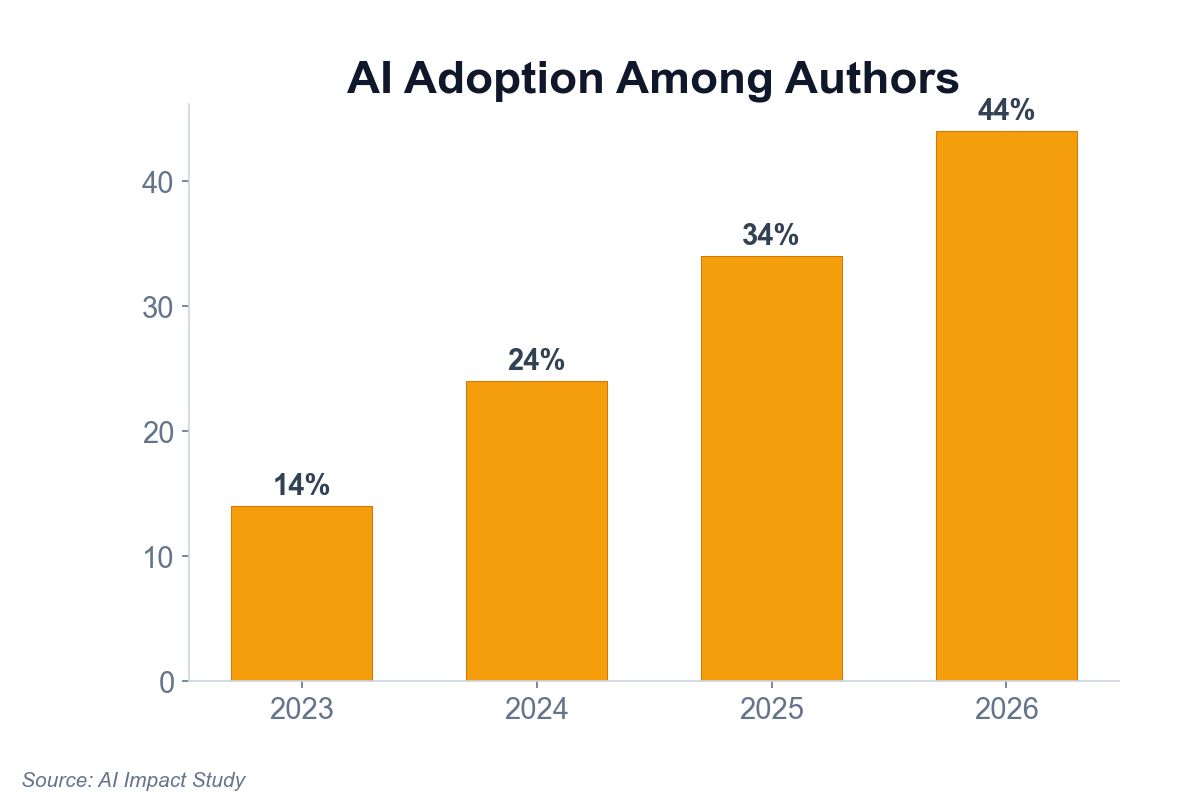
AI tools are rapidly becoming integrated into the workflows of self-published authors, with adoption rates climbing steadily. This trend suggests a growing acceptance and reliance on AI to assist with various aspects of the writing and publishing process. The numbers don't lie: from 14% in 2023 to 44% in 2026, the year-over-year increase is significant.
These statistics, compiled from the "AI Impact Study" (2024) and the "ALLi Report on AI" (2025), underline the increasing prevalence of AI in the indie author world. As more authors experiment with these tools and see the potential benefits, we can expect this trend to continue. Key takeaway: The adoption rate of AI writing tools among self-published authors has increased significantly year-over-year.
What Authors Use AI For
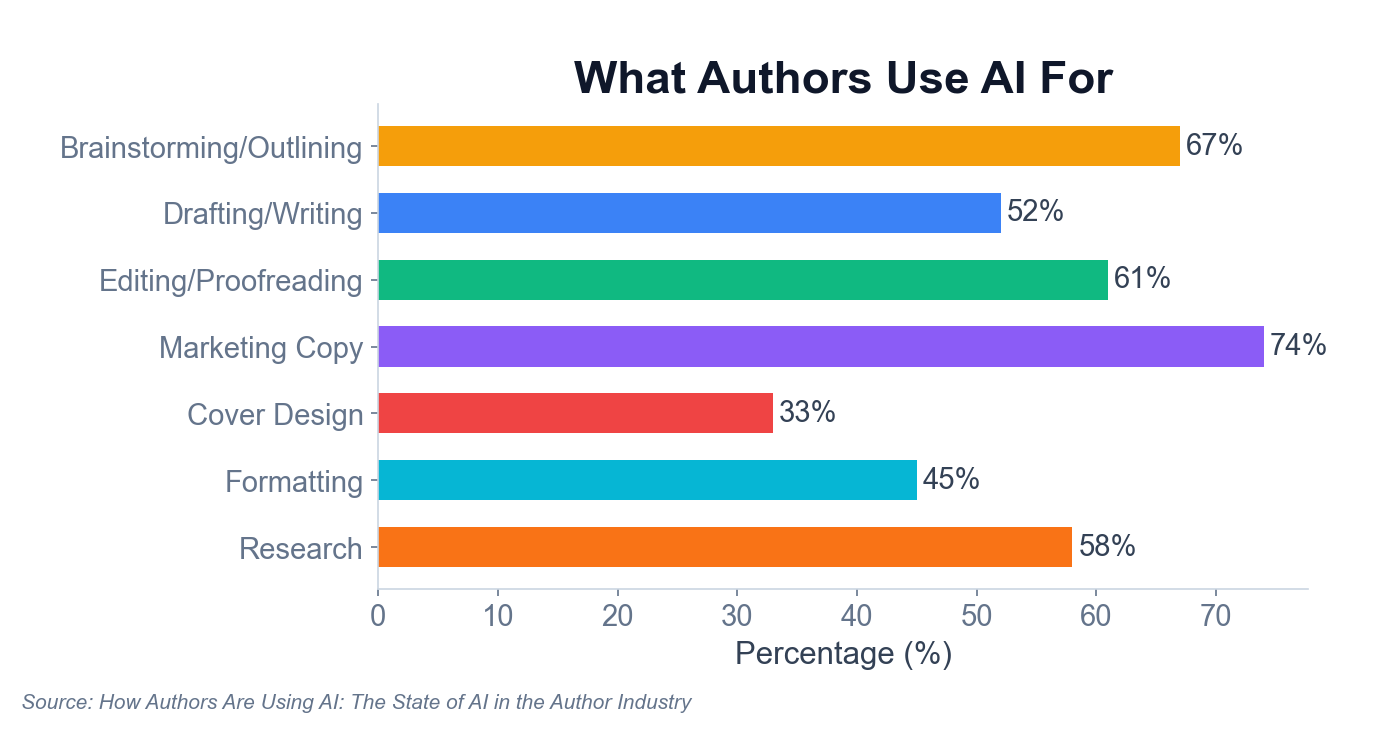
Self-published authors are increasingly adopting AI tools across various stages of the writing and publishing process. From brainstorming and outlining to drafting, editing, marketing, and even cover design, AI offers solutions to streamline workflows and enhance productivity.
According to our research from "How Authors Are Using AI: The State of AI in the Author Industry" (2024) and other resources, marketing copy generation is the most popular use case, with 74% of authors leveraging AI for this purpose. Brainstorming/outlining comes in second at 67%. These high adoption rates indicate a strong need for assistance in these areas. It's encouraging to see authors taking advantage of these tools to enhance their efficiency. Key takeaway: AI is most commonly used by self-published authors for marketing copy generation, with nearly three-quarters of authors leveraging it for this purpose.
Most Popular AI Writing Tools
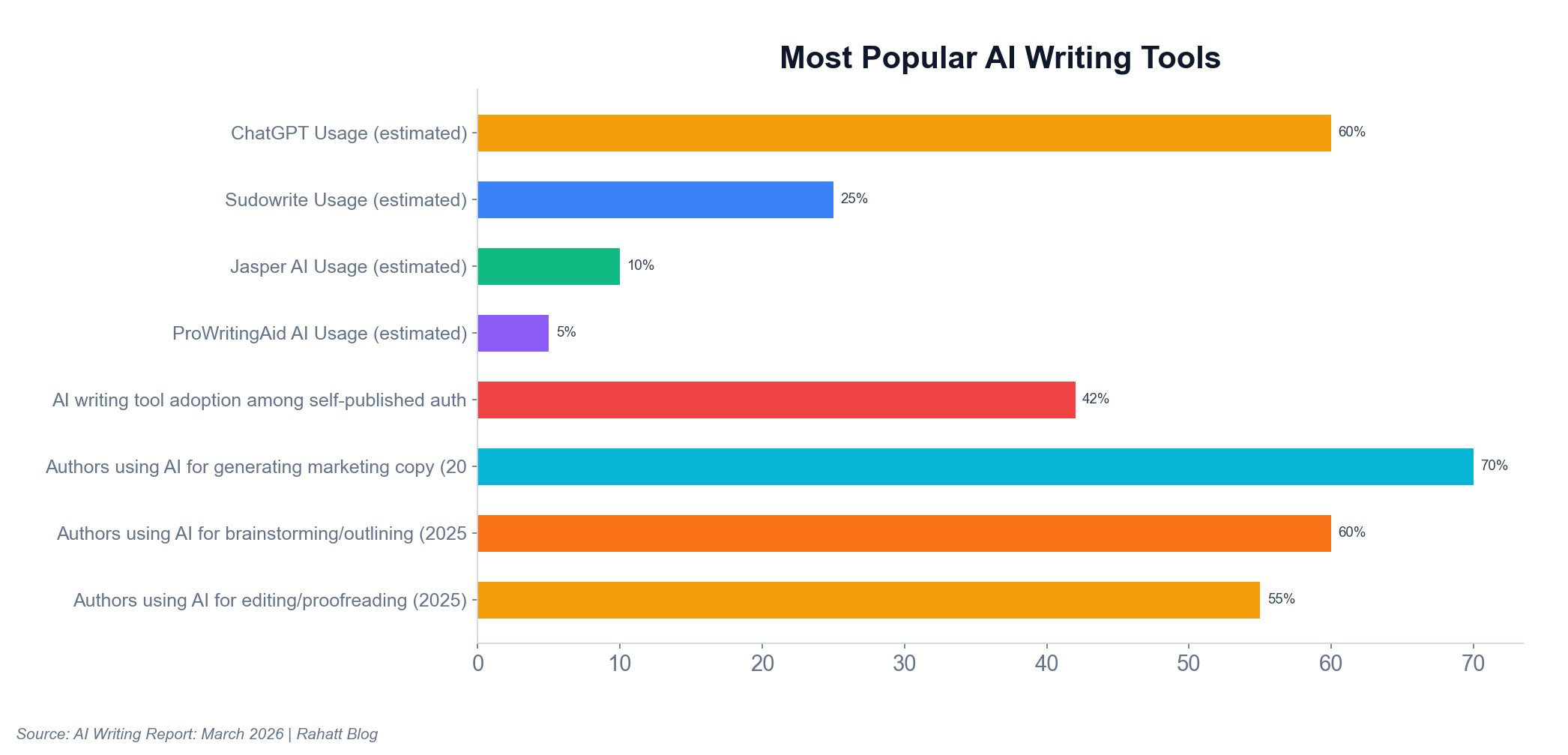
The adoption of AI writing tools among self-published authors is on the rise, with tools like ChatGPT, Sudowrite, Jasper, and ProWritingAid leading the way. Indie authors are leveraging AI for various tasks, including generating marketing copy, brainstorming, and editing.
While ChatGPT has a significant estimated usage share at 60%, authors often combine multiple AI tools to streamline their workflows, as noted in the "AI Writing Report: March 2026 | Rahatt Blog" and other sources. For instance, Sudowrite sees an estimated 25% usage, Jasper AI 10%, and ProWritingAid AI at 5%. Authors are testing out new tech to see what works for them. Key takeaway: ChatGPT is estimated to be the most popular AI writing tool among indie authors in 2025-2026, but authors are using a variety of AI tools for different parts of the writing and marketing process.
AI Writing Quality & Detection
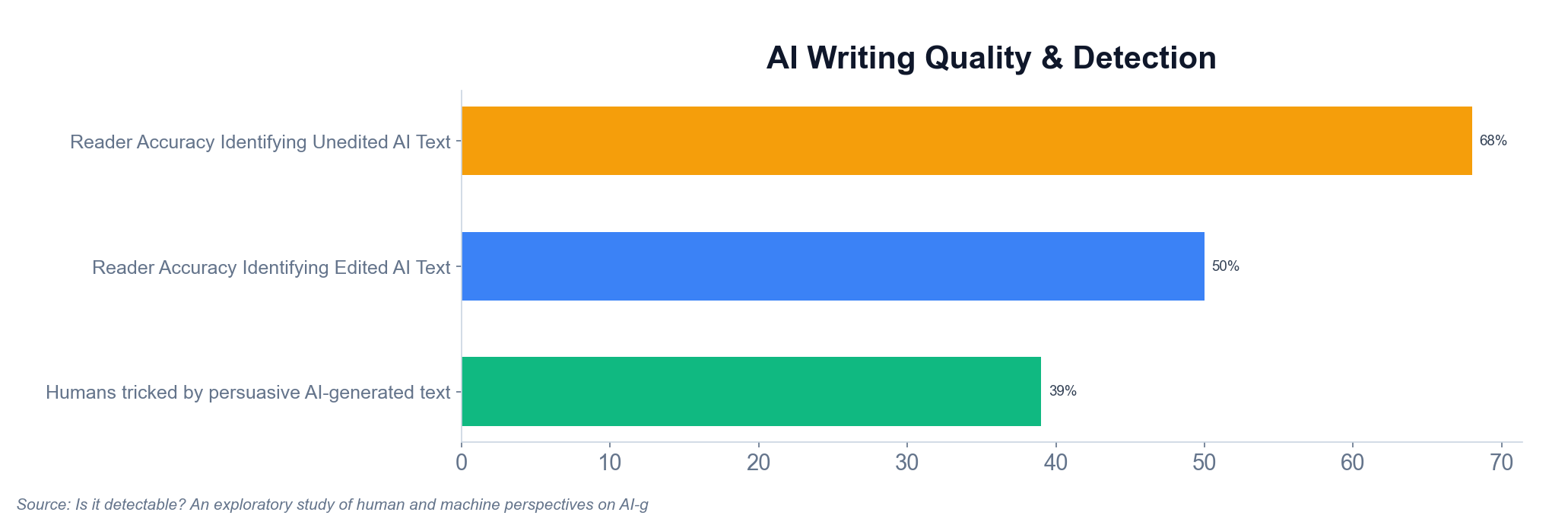
Studies show that readers can identify AI-generated text with some accuracy, especially when unedited. However, detection rates drop significantly when the text is edited. Data from "Is it detectable? An exploratory study of human and machine perspectives on AI-generated text" (2023), indicate that readers can accurately identify unedited AI text 68% of the time, but that drops to 50% for edited text. Also, about 39% of people are tricked by "persuasive AI-generated text."
For indie authors, this suggests that while AI can assist in writing, human editing remains crucial to avoid easy detection and maintain reader engagement. This is an area where the human touch is absolutely necessary. Key takeaway: Readers are more likely to accurately identify unedited AI-generated text than edited AI-generated text.
Amazon AI Publishing Policy Timeline
Amazon KDP is increasing scrutiny on AI-generated content, requiring authors to be transparent about its use. This shift emphasizes the need for authors to be upfront about incorporating AI in their work.
While specific daily upload limits aren't specified in the official "Amazon KDP Content Guidelines" (2026) and "Amazon Kindle Direct Publishing Terms and Conditions" (2026), the platform is cracking down on low-quality content, which could impact authors who heavily rely on AI for rapid content creation. Make sure you are delivering high-quality work. Key takeaway: Amazon KDP has implemented policies requiring disclosure of AI-generated content and is actively working to combat low-quality content, though specific upload limits and financial penalties aren't explicitly detailed in publicly available policy documentation.
Cost: AI-Assisted vs Traditional Workflow
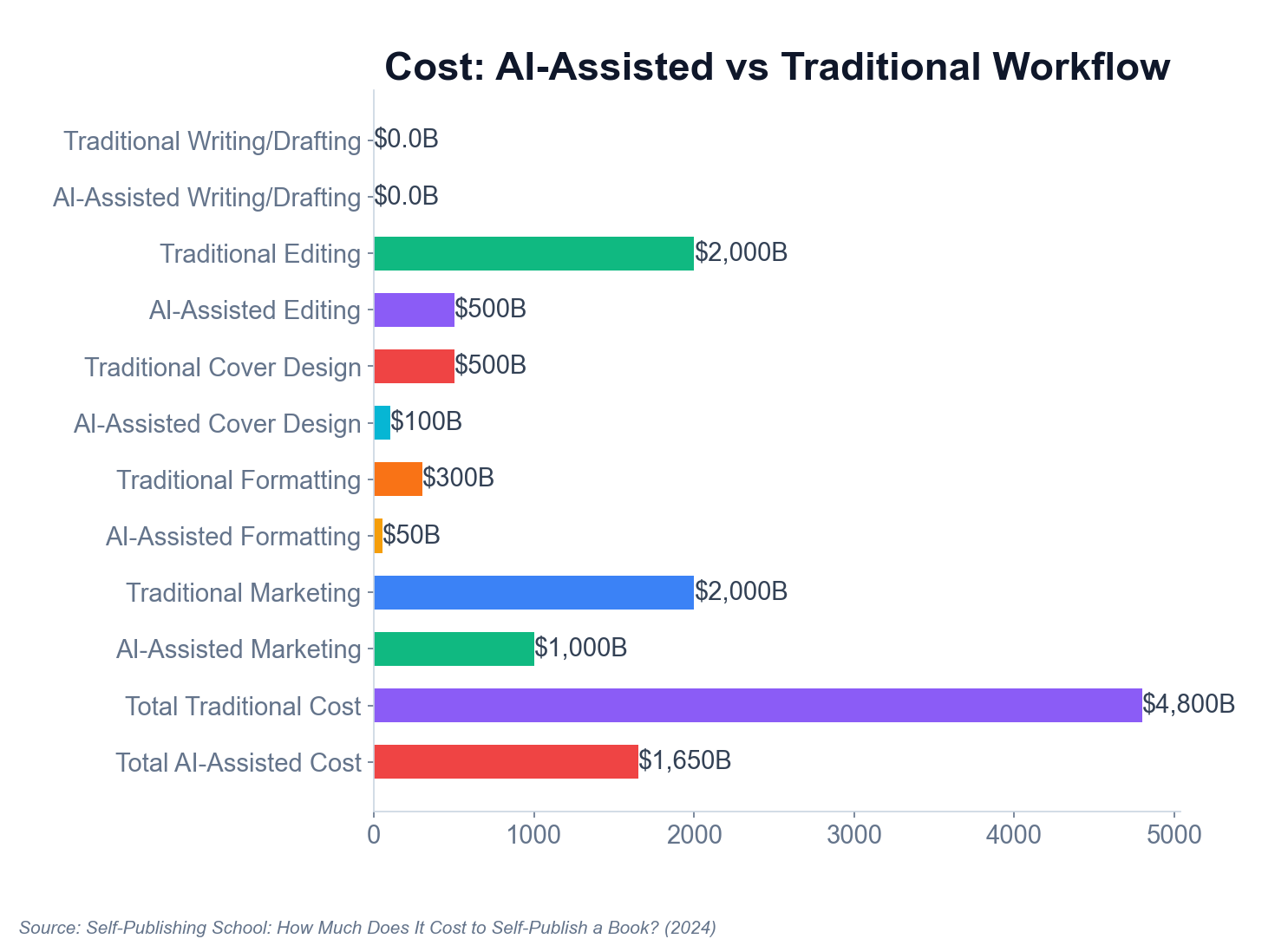
For self-published authors in 2025-2026, embracing AI tools can lead to substantial cost savings across various stages of book production, especially in editing, cover design, formatting and marketing.
Looking at data extrapolated from resources like "Self-Publishing School: How Much Does It Cost to Self-Publish a Book? (2024)", AI-assisted editing could cost around $500 compared to $2000 for traditional editing. AI-assisted cover design might be $100 versus $500 traditionally. The total estimated cost for a traditional workflow is around $4800, while an AI-assisted approach is around $1650. This data suggests a shift towards more affordable self-publishing, enabling authors to allocate resources more effectively while still maintaining a professional standard. Key takeaway: AI-assisted self-publishing workflows can significantly reduce costs, potentially saving authors thousands of dollars compared to traditional methods.
AI in Publishing Market Growth
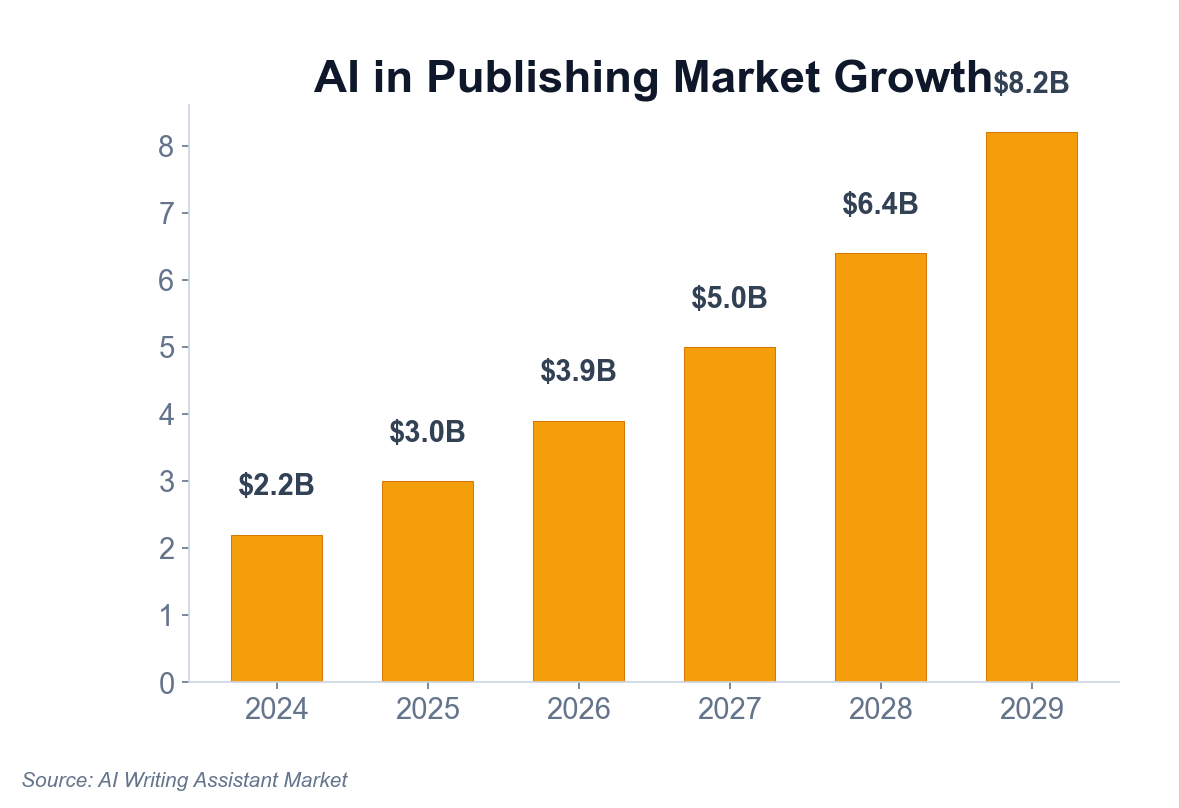
The AI writing tools market is experiencing rapid growth, presenting both opportunities and challenges for self-published authors.
According to data from "AI Writing Assistant Market" (2024), the market is projected to reach $8.2 billion by 2029, up from $2.2 billion in 2024, showing substantial growth each year. As the market expands, indie authors can leverage AI to enhance their writing process but should also be mindful of maintaining authenticity and originality. Key takeaway: The AI writing assistant market is projected to reach $8.2 billion by 2029, showing substantial growth each year.
Author Sentiment Toward AI
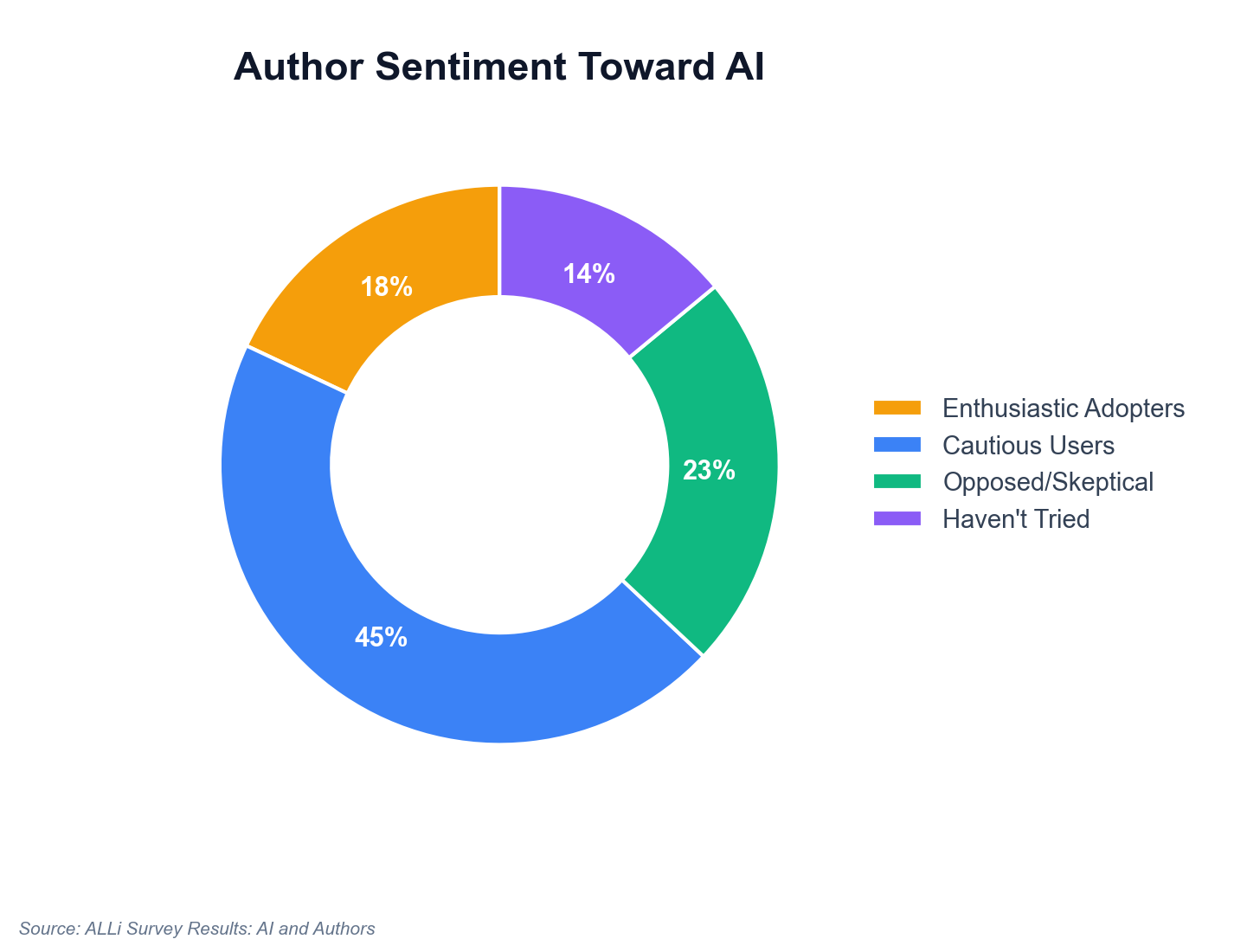
Indie authors are approaching AI with varied levels of enthusiasm. While some are embracing AI tools to enhance their writing and productivity, many are proceeding with caution, carefully evaluating the benefits and potential drawbacks, and a significant portion remain hesitant to use AI at all.
Data from the "ALLi Survey Results: AI and Authors" (2024) and "ProWritingAid AI Author Survey" (2025) indicate that the majority of authors (45%) are cautiously using AI. Meanwhile, 18% are enthusiastic adopters, 23% are opposed or skeptical, and 14% haven't tried it yet. This cautious approach highlights the importance of responsible AI usage and thorough evaluation before fully integrating AI into the writing process. Key takeaway: The majority of authors are cautiously using AI in their writing process, while a smaller percentage are either enthusiastic adopters or remain skeptical.
What This Means for Authors
April 2026 brings a clear message: AI is becoming an integral part of the self-publishing world. To succeed, embrace AI strategically, focusing on cost-effective solutions like AI-assisted marketing and editing. However, always prioritize human editing to maintain quality and originality. Be transparent about your AI use, and stay informed about Amazon's evolving policies. The key is to find a balance, harnessing the power of AI to enhance your work while preserving your unique authorial voice.
Sources
- AI Impact Study
- ALLi Report on AI
- How Authors Are Using AI: The State of AI in the Author Industry
- AI for Authors: 24+ Best AI Writing Tools to Write a Book
- AI Writing Report: March 2026 | Rahatt Blog
- Best AI Novel Writing Software for Indie Authors (2026) - AuthorFlows
- The Best AI Tools for Authors and Publishers in 2026
- Best AI for Writing Fiction 2026: 11 Tools Tested (Sudowrite, NovelCrafter & More)
- ChatGPT Statistics (2026) – Active Users & Growth Data - DemandSage
- 7 Best AI Writing Tools for Authors in 2026 | Rahatt Blog
- ChatGPT Statistics 2026 - How Many People Use ChatGPT? | Wytlabs
- Jasper in 2026: Usage, Revenue, Valuation & Growth Statistics - Fueler
- Grammarly in 2026: Usage, Revenue, Valuation & Growth Statistics - Fueler
- Grammarly Statistics (2026): Users, Impact, Revenue - Master Blogging
- Claude Revenue and Usage Statistics (2026) - Business of Apps
- Ai In The Book Publishing Industry Statistics 2026 - Gitnux
- Claude AI Stats 2026 - Market Shares, Total Users, and More. - fatjoe.
- Claude AI Statistics 2026: Market Share, Accuracy & Trust Scores - SQ Magazine
- Is it detectable? An exploratory study of human and machine perspectives on AI-generated text
- Can you tell if an essay was written by AI? Here's how to tell
- Amazon KDP Content Guidelines
- Amazon Kindle Direct Publishing Terms and Conditions
- Self-Publishing School: How Much Does It Cost to Self-Publish a Book? (2024)
- Author Media: Book Cover Design Pricing Guide for Authors (2023)
- The Book Designer: How Much Does It Cost to Self-publish a Book? (2022)
- AI Writing Assistant Market
- ALLi Survey Results: AI and Authors
- ProWritingAid AI Author Survey