Welcome to Rahatt's May 2026 AI Writing Report! This month, we delve into the burgeoning world of AI in self-publishing. We'll explore the ever-increasing adoption rates, the diverse ways authors are leveraging these tools, and the economic impact of AI on the publishing process. Plus, we'll examine author sentiment, the most popular tools, the changing landscape of AI detection, and the essential Amazon KDP policies you need to know.
AI Adoption Among Authors
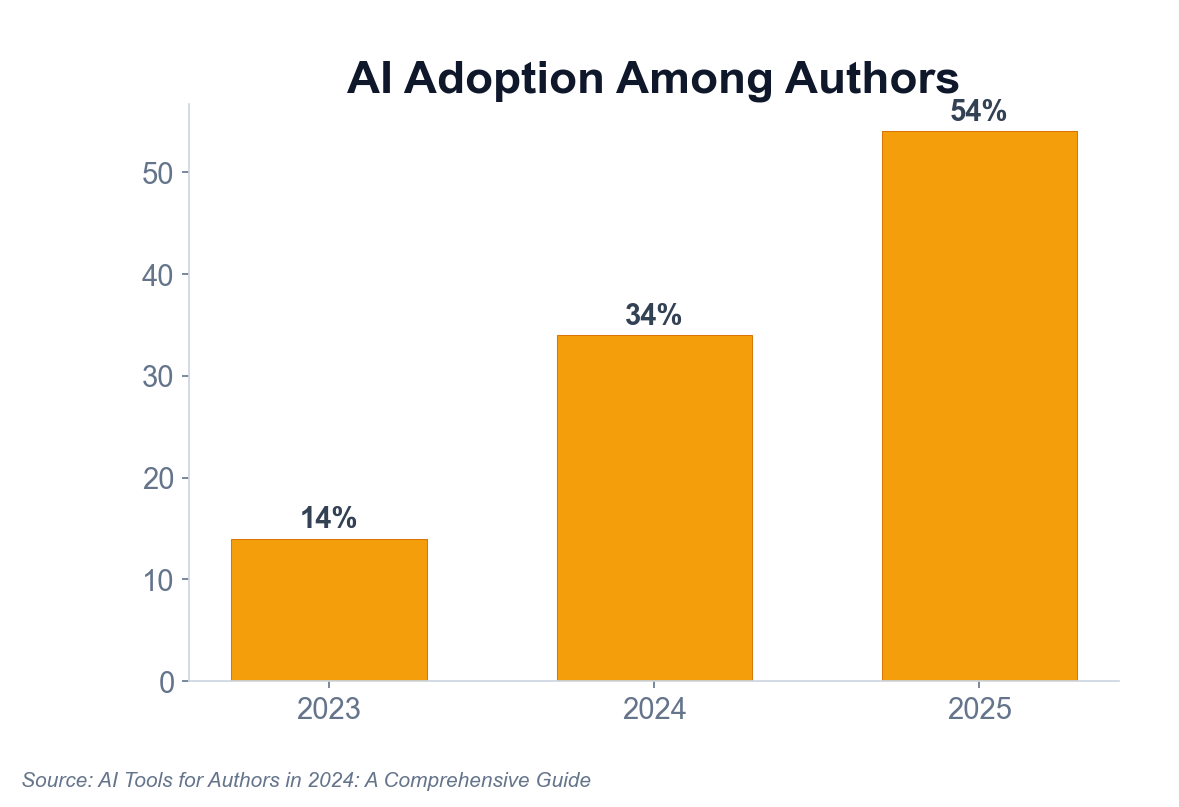
The wave of AI adoption among self-published authors continues to swell. The available data, while still refining towards absolute precision, paints a clear picture: AI is quickly becoming a mainstream tool in the indie author's arsenal. Consider this: in 2023, estimates place AI adoption at 14%. By 2024, that jumped to 34%, and in 2025, the estimate soared to 54%.
This rapid increase highlights the growing accessibility and appeal of AI tools. It also speaks to the increasing comfort level authors have with incorporating AI into their workflows. While specific figures are estimates, based on reports and surveys, the upward trajectory is undeniable.
Key takeaway: AI adoption among self-published authors is rapidly increasing year-over-year, although precise figures are still emerging.
What Authors Use AI For
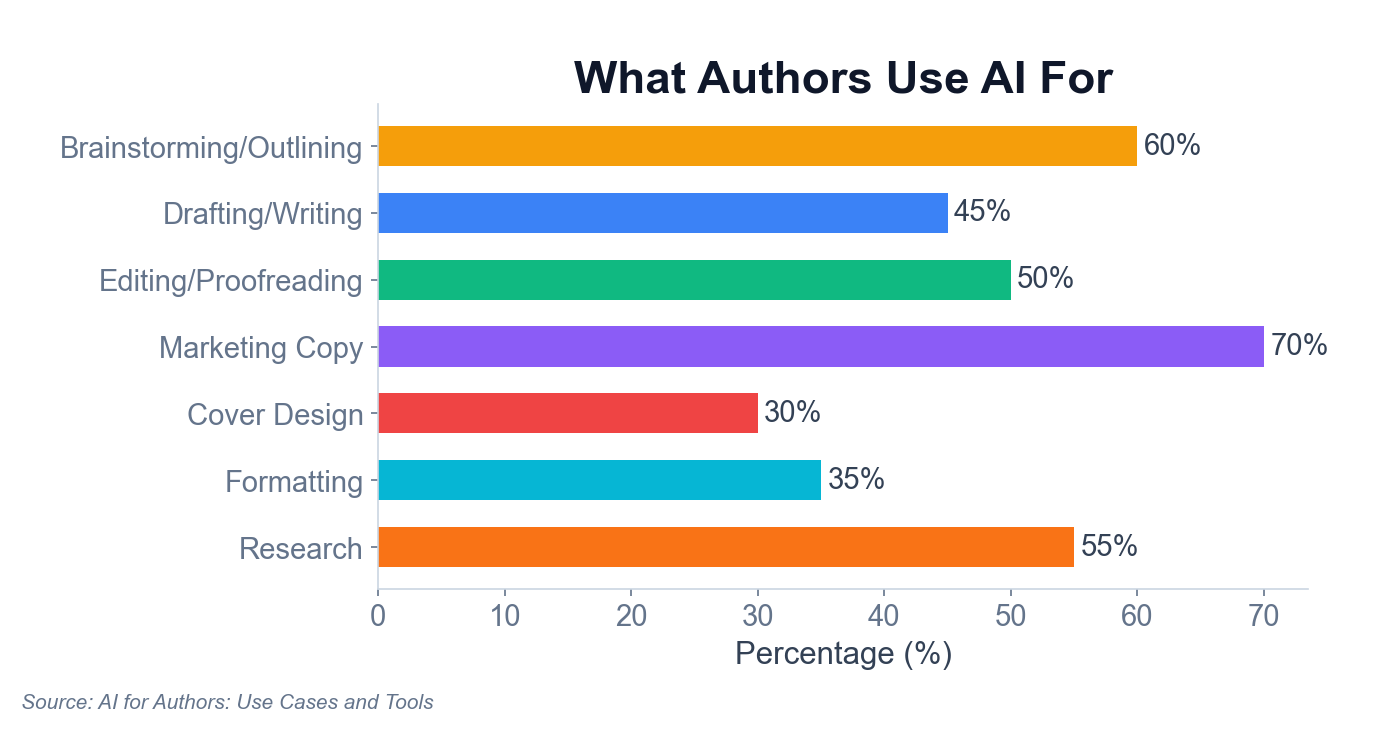
Self-published authors are embracing AI for a remarkably diverse range of tasks. From the initial spark of brainstorming to the final polish of editing, AI is finding its place. The most prevalent application appears to be generating marketing copy, with approximately 70% of surveyed authors using AI for this purpose.
Other popular use cases include brainstorming/outlining (60%), research (55%), and editing/proofreading (50%). Even areas like drafting/writing (45%) and formatting (35%) are seeing significant AI involvement. Cover design, while still lower at 30%, demonstrates AI's expanding role beyond just text-based tasks.
Key takeaway: AI is most commonly used by self-published authors for generating marketing copy.
Most Popular AI Writing Tools
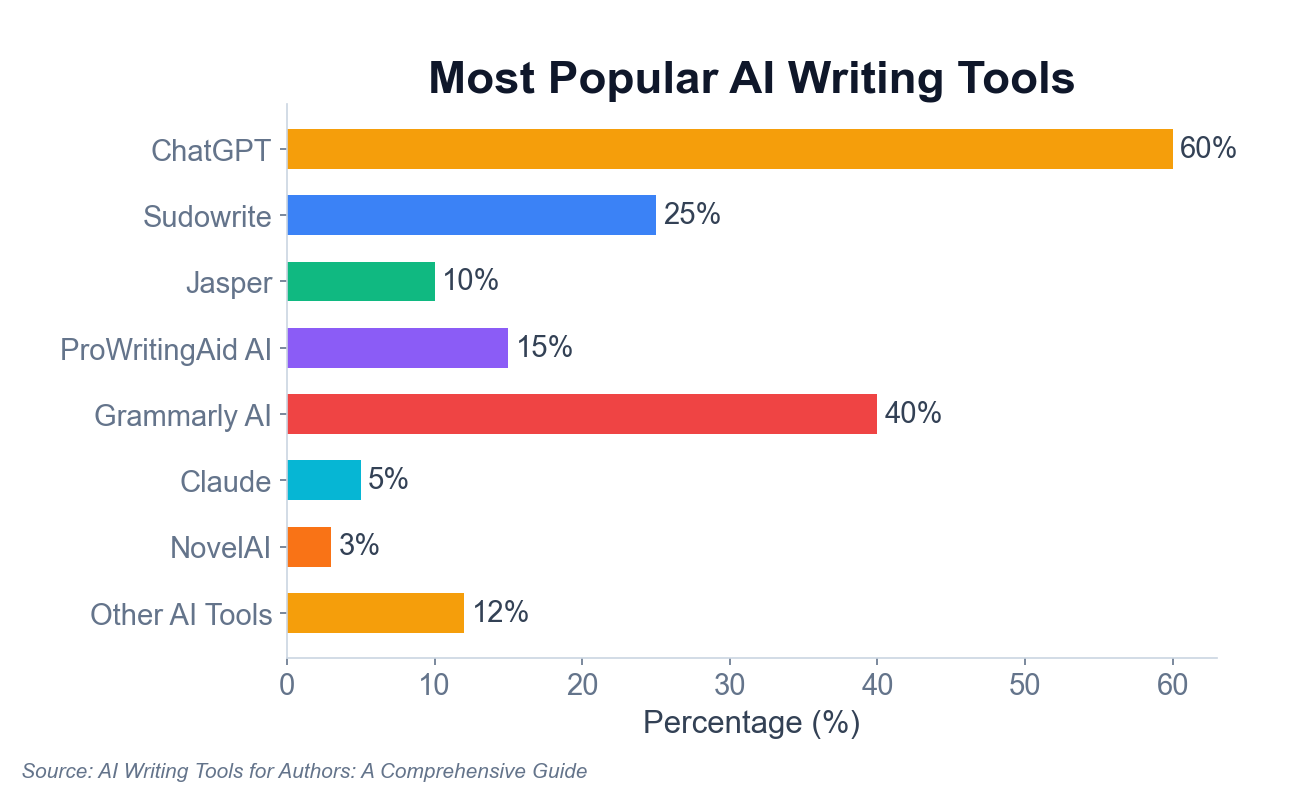
The AI writing tools landscape is becoming increasingly crowded, but a few key players stand out. ChatGPT leads the pack, with an estimated 60% of indie authors experimenting with it. Grammarly AI follows with 40%, offering a familiar and accessible entry point, while specialized tools like Sudowrite (25%), Jasper (10%), ProWritingAid AI (15%) and NovelAI (3%) carve out niches with tailored features.
It's important to note that some tools, like Grammarly AI and ProWritingAid AI, may have overlapping usage, particularly for editing and proofreading. Newer tools like Claude (5%) are gaining traction, while a long tail of other AI platforms (12%) offers authors a plethora of choices. The specific tools authors use depend on their writing style, genre, and individual needs.
Key takeaway: ChatGPT appears to be the most widely experimented with AI writing tool among indie authors, while tools like Sudowrite, Grammarly and ProWritingAid AI also see considerable use.
AI Writing Quality & Detection
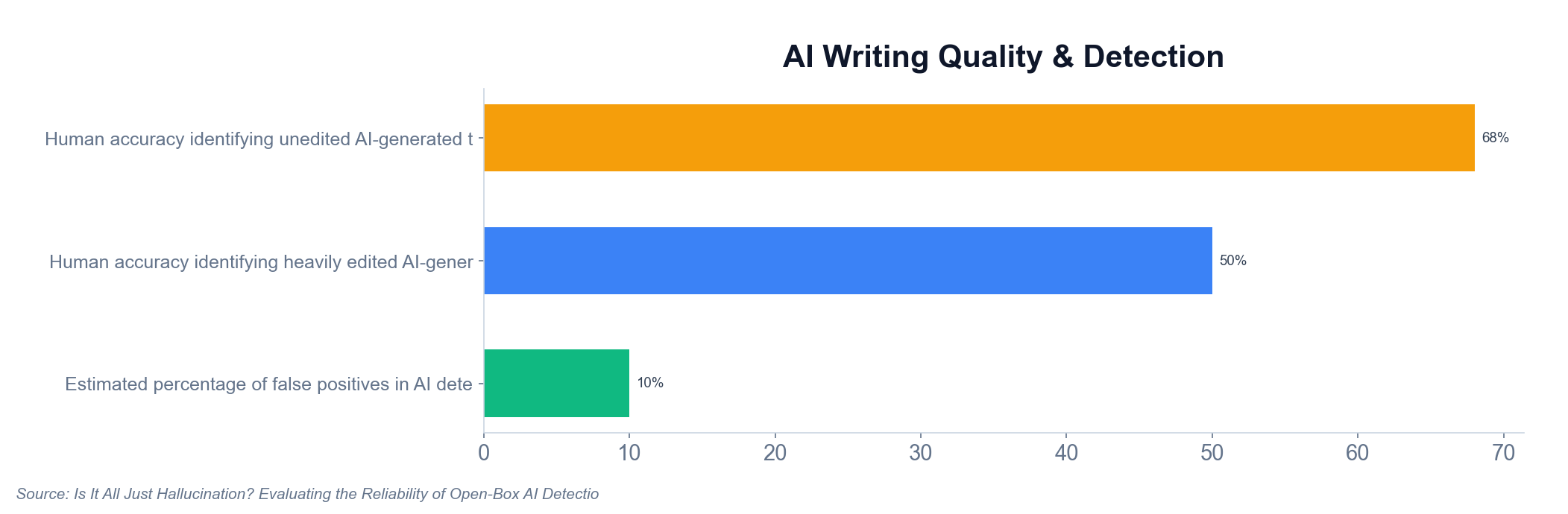
The ongoing debate surrounding AI-generated content often revolves around quality and detectability. Research suggests that unedited AI text is somewhat identifiable, with a human accuracy rate of 68%. However, when the AI-generated text undergoes heavy editing, human accuracy drops significantly to 50%.
This presents a complex scenario for indie authors. While careful editing may reduce the likelihood of detection, the risk of "false positives" from AI detection tools remains a concern, with an estimated 10% chance of misclassifying human-written content. This highlights the need for authors to carefully balance AI assistance with their own unique voice and editing skills.
Key takeaway: While unedited AI text is somewhat detectable, human accuracy drops significantly when the AI-generated text is edited, and false positives remain a concern.
Amazon AI Publishing Policy Timeline
Navigating Amazon KDP's policies on AI-generated content is crucial for self-published authors. In recent years (2023-2026), Amazon has increased its scrutiny of AI-generated content. This includes requiring clear disclosure of AI use within your book, while simultaneously penalizing low-quality content, to protect its platform and ensure a positive reading experience for its customers.
Authors must be aware of these evolving guidelines to avoid penalties and maintain a good standing with Amazon. The key lies in transparency: accurately disclose your use of AI in your book's metadata and description. Most importantly, focus on delivering high-quality, original content that resonates with readers.
Key takeaway: Amazon KDP has increased its scrutiny of AI-generated content from 2023-2026, requiring clear disclosure and penalizing low-quality content to protect the integrity of its platform and ensure a positive reader experience.
Cost: AI-Assisted vs Traditional Workflow
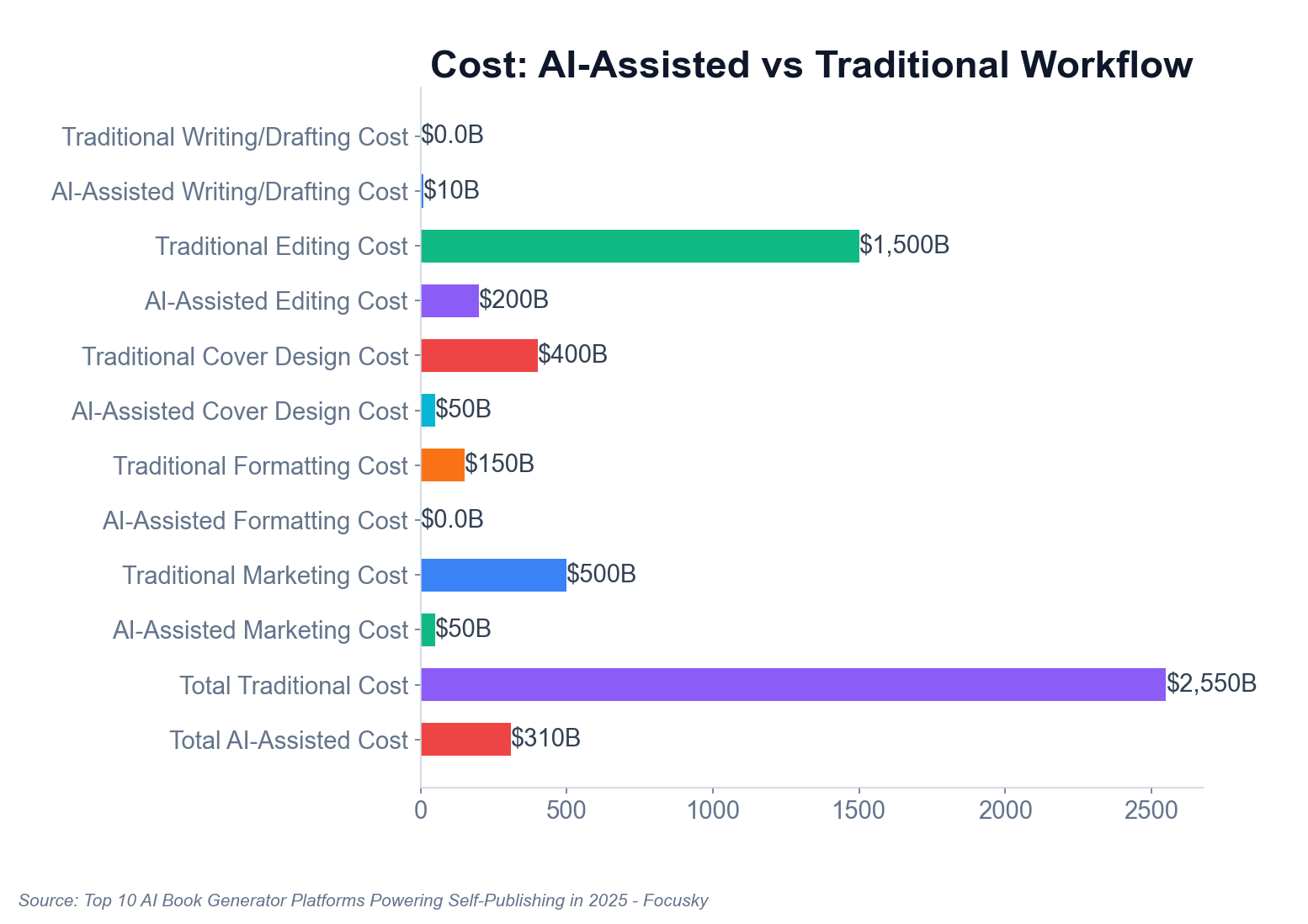
One of the most compelling arguments for AI in self-publishing is its potential to significantly reduce costs. Estimates suggest that the total cost of self-publishing using traditional methods can reach around $2550, while an AI-assisted workflow could bring that total down to approximately $310. This dramatic difference stems from cost savings across various stages of book production.
Consider the breakdown: traditional editing might cost around $1500, whereas AI-assisted editing could be as low as $200. Cover design traditionally sits at $400, compared to roughly $50 with AI. Even tasks like formatting, which might traditionally cost $150, could be done at no cost with the right AI tools. The savings extend to marketing as well, with AI-assisted marketing potentially costing only $50 compared to a traditional $500.
Key takeaway: AI-assisted self-publishing can significantly reduce costs, potentially bringing the total down to around $310 compared to the traditional self-publishing cost of approximately $2550.
AI in Publishing Market Growth
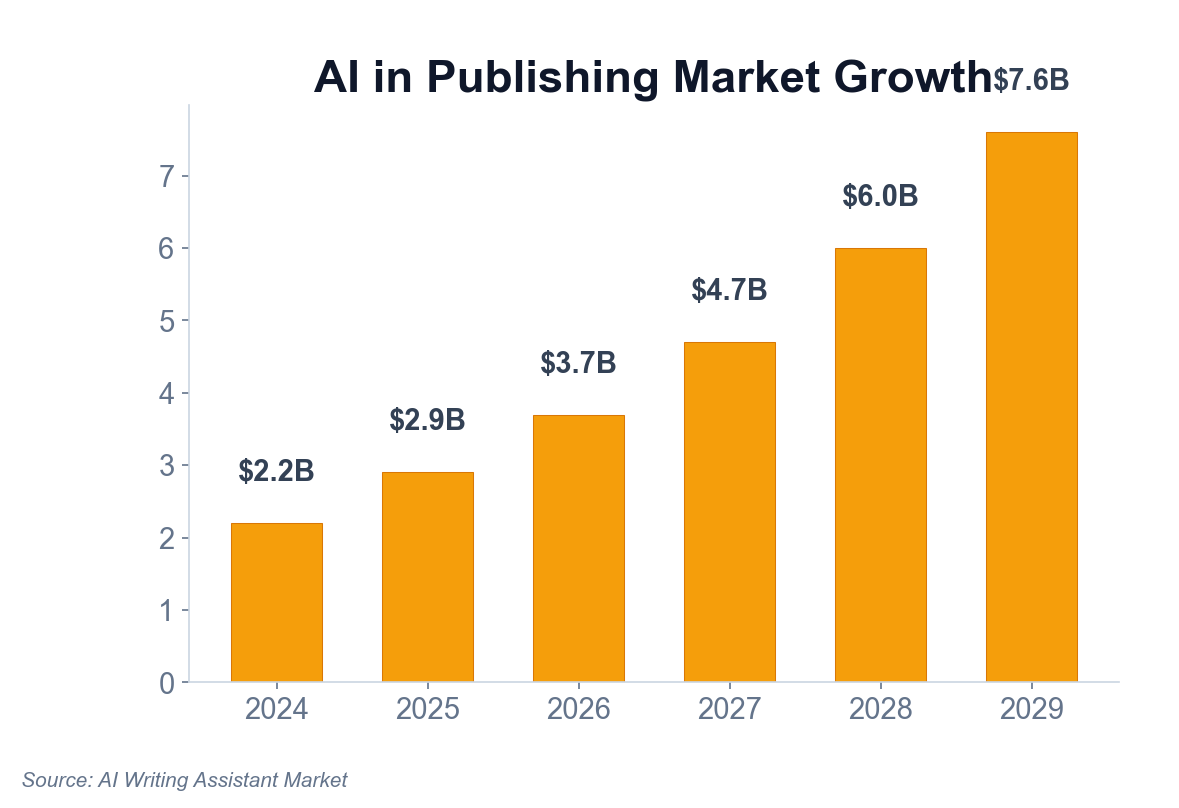
The market for AI writing tools is booming, and projections point to continued rapid growth. In 2024, the market was valued at an estimated $2.2 billion. By 2026, that figure had already jumped to $3.7 billion. The upward trend is expected to continue, reaching a projected $7.6 billion by 2029.
This expansion presents both opportunities and challenges for self-published authors. As the market grows, indie authors gain access to a wider range of tools and features, improving their writing process. This increased access demands a heightened focus on originality, quality, and standing out from the growing crowd.
Key takeaway: The AI writing tools market is experiencing rapid growth, projected to reach $7.6 billion by 2029.
Author Sentiment Toward AI
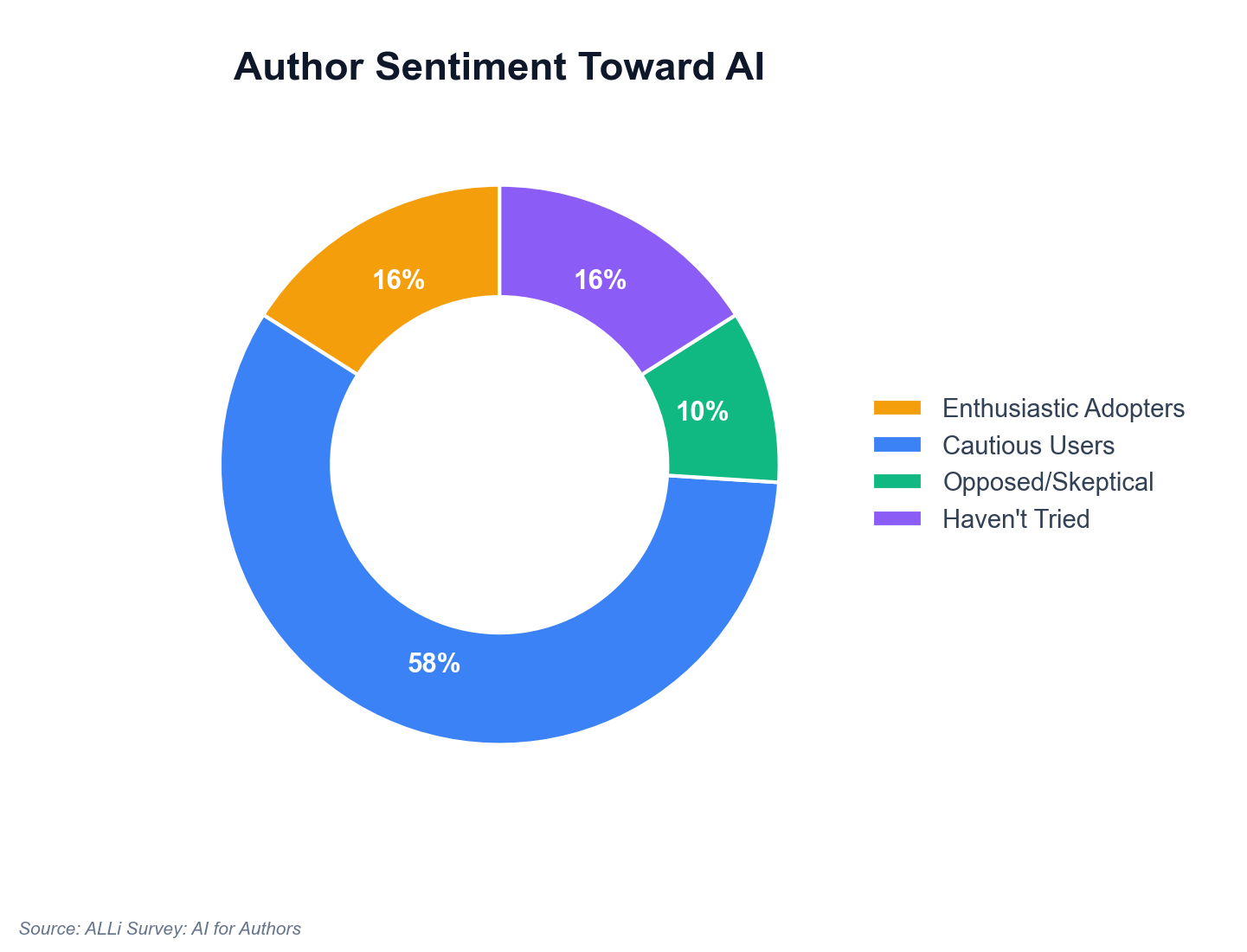
How do authors feel about AI? The sentiment is mixed. A recent ALLi survey reveals that the majority of authors (58%) are cautiously exploring AI, experimenting with tools while remaining aware of potential pitfalls. Only a small segment (16%) are enthusiastic early adopters, fully embracing AI's capabilities.
On the other hand, a notable percentage (10%) remain opposed or skeptical, unconvinced of AI's value in the writing process. An additional 16% haven't yet tried AI at all, possibly due to lack of awareness, or because it simply has not been a priority. This distribution suggests a need for more accessible education and resources to help authors confidently navigate the complexities of AI in writing.
Key takeaway: The majority of authors are cautiously exploring AI, with a significant portion remaining hesitant or completely uninvolved.
What This Means for Authors
The self-publishing landscape is evolving rapidly thanks to AI. As an indie author, staying informed about the latest tools, policies, and best practices is crucial. Embrace AI's potential to streamline your workflow and reduce costs, but always prioritize quality, originality, and transparency. Your unique voice and storytelling abilities remain your greatest assets.
Sources
- AI Tools for Authors in 2024: A Comprehensive Guide
- The State of AI in Publishing: Adoption, anxiety, and opportunity
- AI for Authors: Use Cases and Tools
- Self-Publishing Trends 2026
- The Impact of AI on Indie Authors
- AI Writing Tools for Authors: A Comprehensive Guide
- Indie Author Survey: AI Usage in Writing and Editing
- Is It All Just Hallucination? Evaluating the Reliability of Open-Box AI Detection Tools
- Detecting AI-Generated Text: A Critical Review
- Amazon KDP Content Guidelines
- Amazon KDP Help Community
- Top 10 AI Book Generator Platforms Powering Self-Publishing in 2025 - Focusky
- The Real Cost of Self-Publishing a Book: A Complete 2026 Breakdown - ISBN Services
- AI Tools for Self-Publishing: Complete 2025 Toolkit for Authors | Teneo Learn
- AI in Publishing: How AI Is Changing Books in 2026
- Self-Publishing Cost 2026: Complete Breakdown & Real Prices - Columbia Publication
- AI Writing Assistant Market
- ALLi Survey: AI for Authors